
المدونة
How Custom Wooden Furniture Helps Retailers Stand Out
مقدمة
Custom wooden furniture gives retailers, wholesalers, furniture brands, and distributors an opportunity to develop products that are better suited to their customers instead of competing only with standard furniture already available in the market.
Standard furniture can be useful for many businesses, but it can also create a problem: competitors may be selling very similar products.
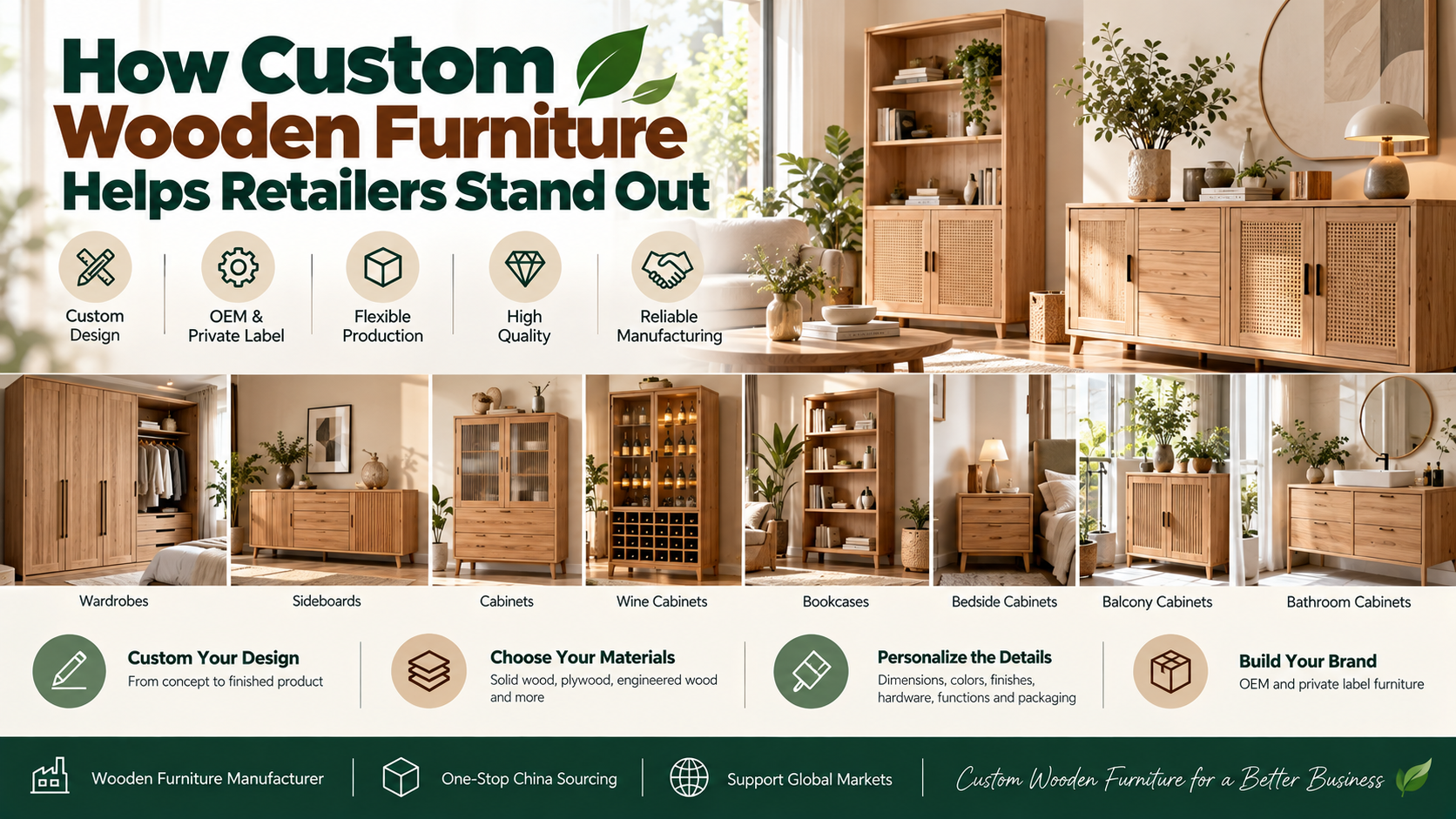
By working with a manufacturer that supports custom development and OEM production, businesses can adjust dimensions, materials, finishes, functions, hardware, packaging, and branding to create a more distinctive product line.
For retailers looking to build a recognizable furniture collection, customization can therefore become more than a production option. It can become part of their overall product strategy.
Why Retailers Need More Than Standard Furniture
Furniture buyers today have access to a large number of standard products.
The same types of cabinets, bookcases, sideboards, and storage furniture can often be found across different retailers and online marketplaces.
When products look almost identical, businesses may have limited ways to differentiate themselves beyond price.
This can lead to:
- Greater price competition
- Lower product differentiation
- Less control over product design
- Difficulty building a unique brand identity
- Limited opportunities to target specific customer groups
Custom furniture provides another approach.
Instead of selecting only from products already available from a supplier, retailers can develop furniture around their own market requirements.
What Is Custom Wooden Furniture?
Custom wooden furniture is furniture manufactured according to specific requirements rather than being limited to a standard factory design.
Customization can range from relatively simple changes to completely new product development.
For example, a retailer may request:
- Different dimensions
- Different wood materials
- New colors
- Different surface finishes
- Customized hardware
- Additional storage
- Different functions
- Modified structures
- Branded packaging
- Private-label production
The level of customization depends on the manufacturer’s capabilities and the project requirements.
For some businesses, a small modification to an existing product may be enough. For others, the project may start with a completely new design.
How Custom Furniture Creates Product Differentiation
One of the biggest advantages of custom furniture is differentiation.
Instead of selling exactly the same product as competing retailers, a business can develop a product with its own specifications.
For example, a retailer could take a standard cabinet concept and customize:
Dimensions → Materials → Finish → Hardware → Storage Configuration → Packaging
The result can be a product that looks familiar enough for customers to understand, while still being different enough to create its own identity.
This can be particularly useful for furniture brands that want to develop collections rather than sell individual products.
What Can Be Customized?
The possibilities depend on the product and manufacturing process, but custom wooden furniture can often be modified in several important areas.
1. Dimensions
Furniture needs to fit the spaces where customers will use it.
Retailers may therefore need different dimensions based on:
- Home sizes
- Room layouts
- Market preferences
- Transportation requirements
- Target customer groups
Even relatively small dimensional changes can make a product more suitable for a particular market.
2. Materials
Material selection affects appearance, durability, weight, and cost.
Depending on the product, buyers may consider:
- Solid wood
- Plywood
- Engineered wood
- Different wood species
- Wood veneers
- Other wood-based materials
The best material is not necessarily the most expensive one.
The goal is to find a material that matches the product’s design, intended use, target price, and market positioning.
3. Colors and Finishes
A furniture design can have a completely different appearance depending on its finish.
Retailers may request:
- Natural wood finishes
- Painted finishes
- Matte surfaces
- Gloss finishes
- Specific colors
- Different textures
This gives brands greater control over the visual identity of their collections.
4. Hardware
Hardware can also influence both appearance and functionality.
Examples include:
- Handles
- Hinges
- Drawer slides
- Magnetic closures
- Metal components
- Decorative hardware
Changing hardware can sometimes transform the appearance of an otherwise similar furniture design.
5. Functions
Customization is not limited to appearance.
Furniture can also be developed around specific functions.
For example:
- Additional storage
- Adjustable shelves
- Hidden compartments
- Different door configurations
- Multi-purpose furniture
- Space-saving structures
Functional customization can be especially valuable when targeting specific customer needs.
Custom Furniture for Different Market Segments
Different markets do not necessarily want exactly the same furniture.
A product designed for a compact urban apartment may have different requirements from furniture designed for a large house.
Similarly, furniture aimed at budget-conscious customers may use different materials and finishes from products positioned in a premium segment.
Custom manufacturing allows retailers to adjust products according to their target market.
For example:
Modern Home Furniture
Clean lines, simple finishes, and practical storage.
Premium Furniture
Higher-end materials, refined finishes, and more detailed construction.
Space-Saving Furniture
Compact dimensions and multi-functional structures.
Hospitality Furniture
Durability, repeatability, and project-specific dimensions.
This flexibility can help businesses build product collections around specific market segments.
OEM and Private Label Wooden Furniture
For furniture brands, OEM manufacturing can provide another level of flexibility.
Instead of simply purchasing a manufacturer’s existing product, the brand can provide its own requirements and develop products under its own identity.
An OEM project may include:
- Product design
- Technical specifications
- Materials
- Finishes
- Hardware
- Dimensions
- Branding
- Packaging
The manufacturer then produces the furniture according to the agreed specifications.
This allows retailers and brands to build a product range that is more closely connected to their own market positioning.
From Design Concept to Finished Product
A custom furniture project usually involves several stages.
Step 1: Product Concept
The buyer provides an idea, drawing, reference product, dimensions, or design concept.
Step 2: Technical Review
The manufacturer reviews the design and determines whether the product can be manufactured efficiently.
Step 3: Material Selection
Suitable materials, finishes, hardware, and other components are confirmed.
Step 4: Prototype or Sample
A sample can be developed so the buyer can evaluate the actual product.
Step 5: Modification
Dimensions, structure, materials, or finishes can be adjusted based on the sample.
Step 6: Production
Once specifications are approved, the manufacturer moves into mass production.
Step 7: Quality Control and Packaging
The finished products are inspected and prepared for transportation.
A structured development process helps reduce misunderstandings and creates a clear reference for future orders.
MOQ and Production Considerations
Custom manufacturing often requires more planning than purchasing standard products.
Retailers should discuss:
- MOQ
- Sample requirements
- Tooling or development costs
- Production lead time
- Material availability
- Packaging requirements
- Quality standards
MOQ can vary significantly depending on the product, materials, production process, and level of customization.
For businesses testing a new product, it is useful to discuss the minimum practical production quantity with the manufacturer before finalizing the design.
Quality Control for Custom Wooden Furniture
Customization makes quality control even more important because the product may not have a long production history.
Before mass production, buyers should establish clear specifications for:
- Dimensions
- Materials
- Surface finish
- Color
- Hardware
- Structure
- Assembly
- Packaging
An approved sample can also provide an important reference for future production.
For repeat orders, maintaining consistent specifications helps reduce differences between production batches.
Why Work with a Manufacturer Instead of a Trading Company?
When developing custom wooden furniture, working directly with a capable manufacturer can provide greater visibility into the production process.
A manufacturer may be able to provide direct support for:
- Material selection
- Production feasibility
- Product development
- Sampling
- Manufacturing
- Quality control
- Packaging
This can be particularly valuable when a project involves several rounds of product development.
However, manufacturers and sourcing partners can also complement each other.
For businesses that need products beyond the manufacturer’s own production categories, a sourcing partner with access to broader Chinese supply chains can provide additional value.
How Abayabella Supports Custom Wooden Furniture Projects
Abayabella is a wooden furniture and wooden products manufacturer supporting OEM, custom manufacturing, and product development.
Our furniture and wooden product capabilities include:
- Wardrobes
- Sideboards
- Cabinets
- Wine cabinets
- Bookcases
- Bedside cabinets
- Balcony cabinets
- Bathroom cabinets
- Wooden doors
- Flooring
- Wall panels
We can work with customers based on existing designs, product concepts, specifications, or customized requirements.
Our role can extend from product development and manufacturing to packaging and export preparation.
Beyond our own manufacturing capabilities, Abayabella also provides one-stop China sourcing for customers who need additional products or suppliers.
This means a customer can work with us not only for custom wooden furniture, but also for other products that may be required for a broader project.
Wooden Products Manufacturer — https://abayabella.com/wooden-products-manufacturer/
Customization Is About More Than Appearance
It is easy to think of custom furniture as simply changing the color or dimensions of an existing product.
In reality, customization can influence the entire product strategy.
A retailer can use custom manufacturing to determine:
Who the product is for → How it should function → How it should look → What materials should be used → How it should be packaged → How it should be positioned in the market
This creates a closer connection between manufacturing and the retailer’s business strategy.
Building a Unique Furniture Collection
A single custom product can be useful, but a coordinated product collection can provide even greater value.
For example, a retailer could develop a collection around a consistent:
- Wood material
- Color palette
- Hardware style
- Design language
- Packaging style
The collection could then include cabinets, sideboards, bookcases, bedside cabinets, and other complementary products.
This creates a more recognizable product identity than selling unrelated standard products from different suppliers.
Final Thoughts
Custom wooden furniture gives retailers and furniture brands more control over what they sell and how their products are positioned.
Instead of competing solely on products that are available to everyone, businesses can work with manufacturers to develop furniture that reflects their own customers, market, and brand.
The process can involve everything from small modifications to complete OEM product development.
For businesses looking for a long-term manufacturing partner, the most important factors are not only production price but also manufacturing capability, customization experience, product development, quality control, communication, and supply-chain support.
At Abayabella, we combine wooden furniture manufacturing, OEM/custom development, and one-stop China sourcing to help businesses develop differentiated wooden products for different markets.
Unique products start with the right manufacturing partner.
Watch our video: Abayabella on YouTube