
Blog
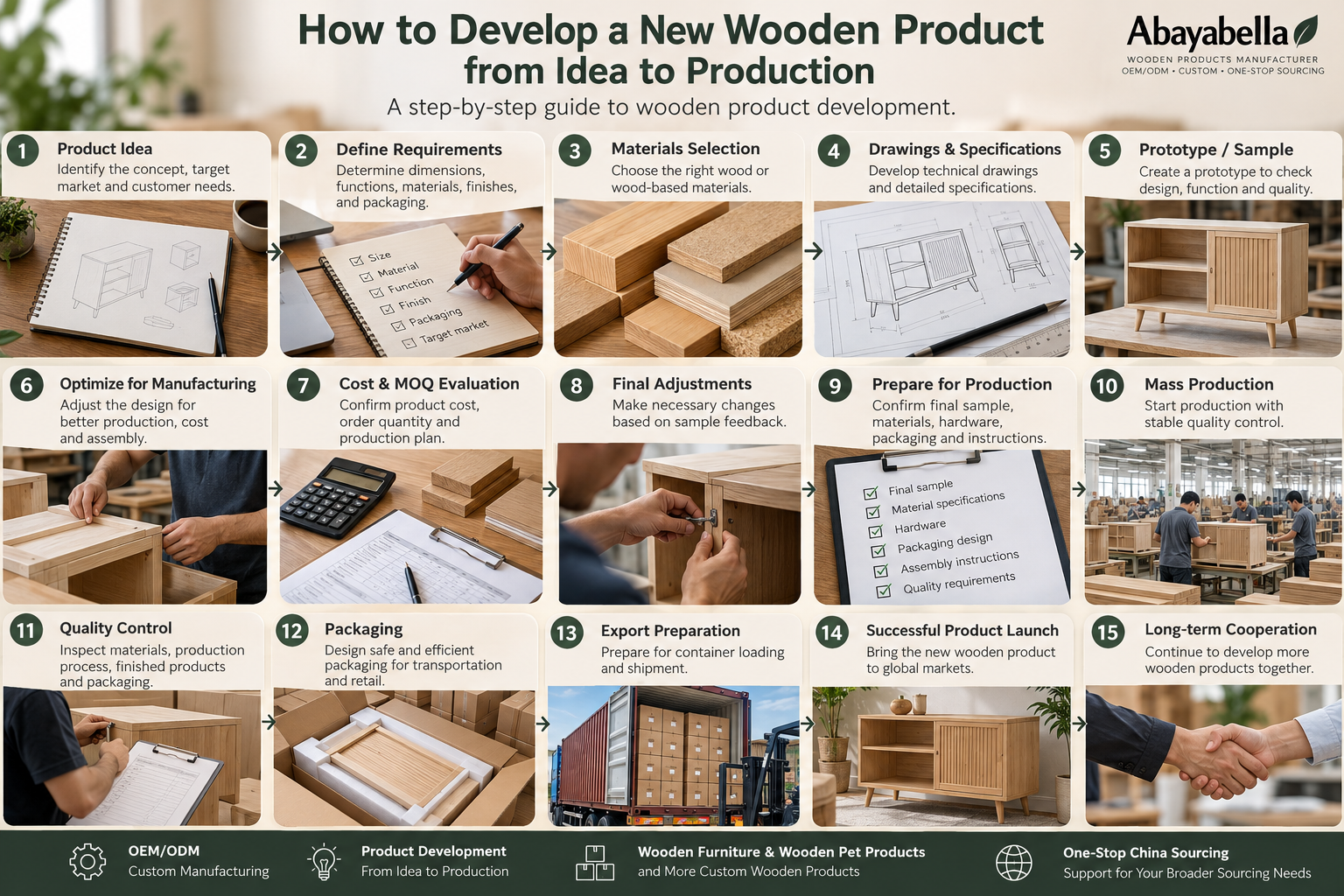
How to Develop a New Wooden Product from Idea to Production
Introduzione
Wooden product development involves much more than simply turning an idea into a finished wooden product. For retailers, wholesalers, brands, and importers, a successful product needs to combine design, functionality, materials, manufacturing feasibility, cost, quality, packaging, and market requirements.
A product may look excellent in a drawing but still be difficult or expensive to manufacture. Therefore, wooden product development requires close coordination between product design and manufacturing from the beginning.
Whether the project involves wooden furniture, wooden pet products, home products, or other custom wood products, a structured development process can reduce unnecessary modifications and make production more efficient.
1. Start with a Clear Product Concept
Every wooden product development project begins with an idea.
The concept may come from:
- A new product idea
- An existing product that needs improvement
- Customer feedback
- A market opportunity
- A retailer’s private-label product
- A product that needs to be redesigned
- A completely new OEM project
At this stage, the product does not need to be perfect.
What matters is defining the basic purpose of the product.
For example, a buyer may want to develop:
- A wooden cat house
- A wooden dog house
- A new cat tree
- A bedside cabinet
- A wardrobe
- A sideboard
- A wine cabinet
- A balcony cabinet
- A wooden storage product
The clearer the intended application, the easier it becomes to determine the appropriate construction and materials.
2. Define the Product Requirements
After establishing the basic concept, the next step is to define the product requirements.
These requirements can include:
- Product dimensions
- Weight capacity
- Intended use
- Target market
- Expected retail price
- Packaging requirements
- Assembly requirements
- Surface finish
- Color
- Hardware
- Functional features
This stage is particularly important for B2B buyers.
A product designed for an online retailer may need compact packaging and easy assembly, while a product intended for a premium furniture store may place greater emphasis on materials, finishing, appearance, and construction.
Therefore, wooden product development should always consider the final market rather than focusing only on appearance.
3. Choose the Right Materials
Material selection has a direct impact on the product’s appearance, strength, weight, cost, and manufacturing process.
Depending on the project, manufacturers may work with different types of wood and wood-based materials.
Common options can include:
- Pine
- Rubber wood
- Paulownia
- Poplar
- Plywood
- MDF
- Other engineered wood materials
The right material depends on the product’s intended application.
For example, a lightweight decorative product may have very different material requirements from a large wardrobe or a structurally demanding pet house.
During wooden product development, buyers should therefore consider material performance together with cost and appearance.
4. Develop Drawings and Product Specifications
Once the basic requirements and materials are determined, the concept needs to become a manufacturable specification.
Technical information may include:
- Overall dimensions
- Individual component sizes
- Material thickness
- Joint structures
- Hardware specifications
- Surface treatment
- Color requirements
- Assembly method
- Packaging dimensions
Clear specifications reduce misunderstandings between buyers and manufacturers.
For OEM projects, this stage can also help manufacturers identify potential production problems before the prototype is produced.
5. Create a Prototype or Sample
A prototype is one of the most important stages of wooden product development.
The first sample allows both the buyer and manufacturer to evaluate the actual product rather than relying only on drawings.
The prototype can be checked for:
- Dimensions
- Appearance
- Stability
- Functionality
- Assembly
- Material selection
- Surface finish
- Hardware
- Packaging requirements
At this point, changes are normal.
The first sample may reveal that a component is too thick, a joint needs adjustment, a function could be improved, or the product needs to be optimized for packaging.
Making these changes before mass production is much more efficient than discovering the same problems after production has started.
6. Optimize the Product for Manufacturing
A product that works well as a prototype is not necessarily ready for mass production.
This is where manufacturing experience becomes particularly valuable.
The manufacturer needs to evaluate questions such as:
- Can the product be produced consistently?
- Are the components easy to process?
- Can the assembly process be simplified?
- Can material waste be reduced?
- Is the hardware suitable?
- Can the product be packed efficiently?
- Can production costs meet the target?
This process is sometimes referred to as design for manufacturing.
Good wooden product development should not only make a product attractive. It should also make the product practical to manufacture at commercial volumes.
7. Evaluate Cost and MOQ
Before moving to mass production, buyers need to understand the commercial side of the project.
The final cost can be affected by:
- Wood or board material
- Product dimensions
- Construction complexity
- Hardware
- Surface treatment
- Labor
- Packaging
- Product testing
- Order quantity
MOQ is also an important consideration.
A highly customized product may require different production arrangements from a standard product.
For retailers and emerging brands, discussing target quantities and target pricing early can help the manufacturer find a more practical production solution.
8. Make Final Adjustments
After reviewing the prototype and quotation, the buyer may request additional changes.
These could include:
- Changing dimensions
- Adjusting colors
- Modifying hardware
- Improving functionality
- Changing material thickness
- Simplifying the structure
- Improving packaging
- Reducing production costs
Several sample revisions may be necessary for a new product.
This is a normal part of wooden product development, particularly when the product is completely new rather than based on an existing manufacturing design.
The goal is to reach a balance between design, quality, functionality, and commercial feasibility.
9. Prepare for Mass Production
Once the product is approved, the manufacturer can prepare for production.
The final production information should normally include:
- Approved sample
- Final drawings
- Material specifications
- Color and finish requirements
- Hardware specifications
- Packaging instructions
- Assembly instructions
- Quality requirements
Keeping these specifications consistent is important for maintaining product quality across production batches.
For B2B customers, this is especially important because retailers and distributors need consistent products when they reorder.
10. Quality Control During Production
Quality control should not begin only when the finished products are ready to ship.
It can be integrated throughout the manufacturing process.
Important checkpoints may include:
Material Inspection
Check the selected wood or board materials before production.
Production Inspection
Monitor cutting, drilling, assembly, sanding, finishing, and other processes.
Finished Product Inspection
Check dimensions, appearance, stability, functionality, hardware, and surface quality.
Packaging Inspection
Confirm that the packaging protects the product adequately during transportation.
A structured quality-control process can help reduce defects and maintain consistency between batches.
11. Packaging Is Part of Product Development
Packaging should not be treated as an afterthought.
For wooden products, packaging needs to consider:
- Product dimensions
- Product weight
- Assembly requirements
- Protection during transportation
- Retail packaging requirements
- Shipping efficiency
- Storage requirements
For e-commerce products, packaging can be even more important because products may pass through several stages of transportation before reaching the final customer.
Therefore, packaging should be considered during wooden product development, rather than being designed only after production is complete.
12. OEM and ODM Can Simplify Product Development
For businesses that do not have their own manufacturing facilities, working with an OEM or ODM manufacturer can make the development process more practical.
An experienced manufacturer may support:
- Product development
- Material selection
- Prototype production
- Manufacturing optimization
- Cost evaluation
- Quality control
- Packaging
- Mass production
With OEM manufacturing, the buyer may provide drawings, specifications, or an existing concept.
With ODM manufacturing, the manufacturer can provide more support in developing the product based on the customer’s requirements.
For businesses developing several products, working with one capable manufacturing partner can also reduce communication between different suppliers.
13. Wooden Product Development for Different Industries
The wooden product development process can be applied to many different product categories.
Furniture
Custom furniture development can include wardrobes, cabinets, sideboards, bookcases, bedside cabinets, wine cabinets, and other indoor furniture.
Pet Products
Wooden pet houses, cat furniture, dog houses, rabbit hutches, and other pet products can also be developed through OEM and custom manufacturing.
Home Products
Storage products, decorative products, doors, wall panels, and other wooden home products can be developed according to different market requirements.
Commercial Products
Retail displays, hotel products, storage solutions, and other commercial wooden products may require customized dimensions and functions.
This flexibility is one reason why professional wooden product development can create opportunities across different industries.
14. Why Manufacturing Experience Matters
Product development and manufacturing cannot always be separated.
A designer may create an attractive product, but the manufacturer understands how that design will behave during cutting, assembly, finishing, packaging, and mass production.
This manufacturing knowledge can help identify potential issues early.
For example, a manufacturer may recommend changing a structure to improve stability, adjusting material thickness, simplifying a component, or modifying packaging to reduce transportation risks.
This type of practical feedback can make the development process more efficient.
15. How Abayabella Supports Wooden Product Development
Abayabella combines wooden product manufacturing, OEM/ODM, custom product development, and one-stop China sourcing.
Our capabilities cover different types of wooden products, including wooden furniture, wooden pet products, and other custom wood products.
For customers developing a new product, we can support different stages of the process, including concept discussion, material selection, sample development, manufacturing, quality control, packaging, and export preparation.
For businesses that need more than wooden products, our one-stop sourcing service can also help source other products from China according to the customer’s requirements.
This means customers do not necessarily need to manage every product category through separate suppliers.
For more information about our manufacturing capabilities:
Wooden Products Manufacturer
https://abayabella.com/wooden-products-manufacturer/
Final Thoughts
Successful wooden product development is a process rather than a single manufacturing step.
From the initial concept and material selection to prototyping, cost evaluation, manufacturing optimization, quality control, and packaging, every stage can influence the final product.
For retailers, wholesalers, brands, and importers, working with a manufacturer that can participate in product development can make the process more efficient and help turn an idea into a commercially viable product.
At Abayabella, we combine wooden product manufacturing, OEM/ODM, custom development, and one-stop China sourcing to help customers develop and manufacture products for different markets.
Whether you already have a complete design or only an initial product idea, a structured development process can be the first step toward building a successful wooden product line.