
Blog
What Makes Wooden Products Suitable for Different Markets?
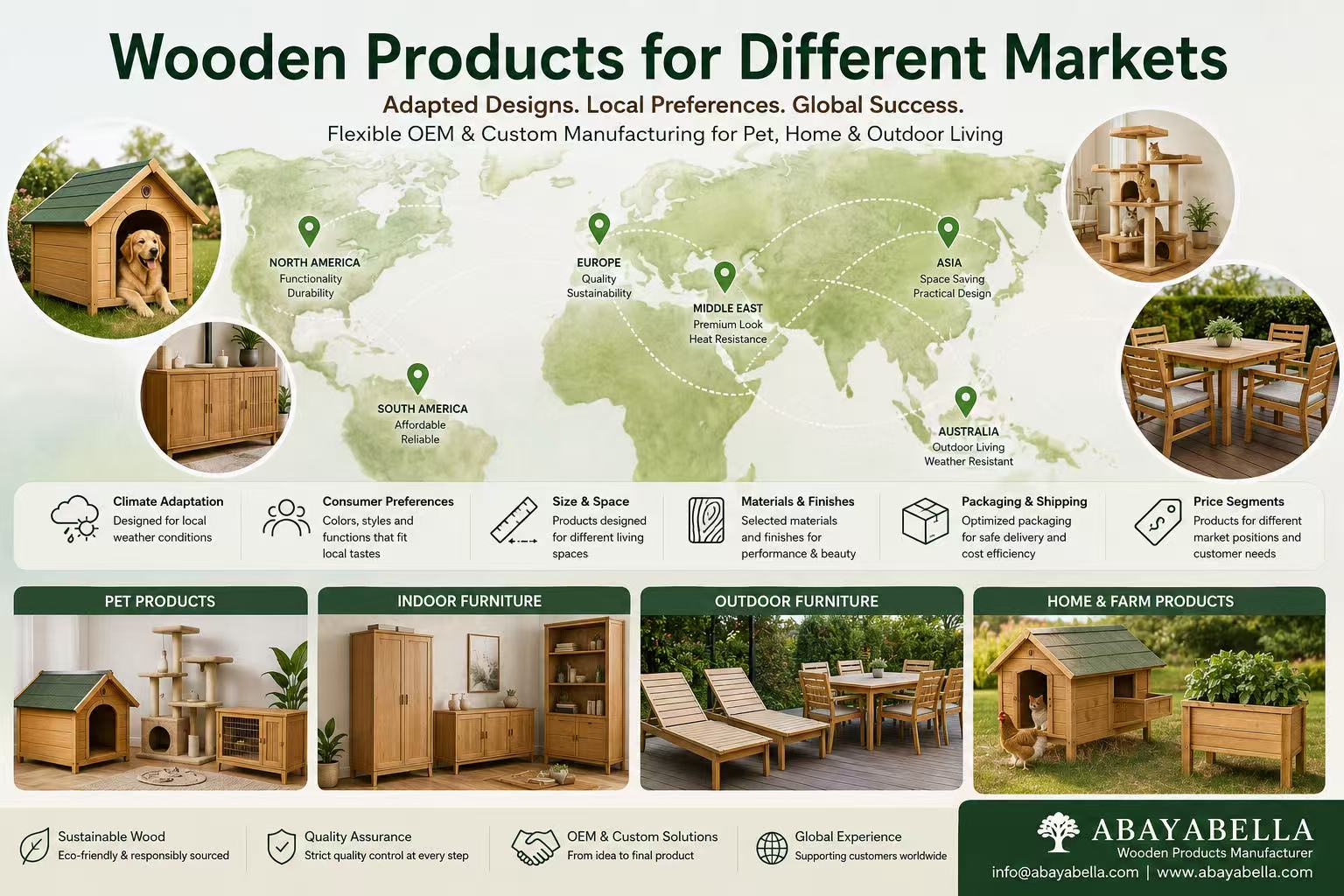
The global market for wooden products is highly diverse. A product that performs well in one country may not necessarily be the best solution for another market.
For B2B buyers, this means that choosing a wooden product is not simply about selecting a design from a catalog. Wooden products for different markets often need to be adapted according to climate, consumer preferences, available space, product positioning, transportation requirements, and price expectations.
This is particularly important for businesses sourcing pet products, indoor furniture, outdoor furniture, and home & farm products.
A flexible manufacturing approach allows brands, distributors, wholesalers, and importers to develop products that are better suited to their individual markets.
Climate and Weather Conditions
Climate is one of the first factors to consider when developing wooden products for different markets.
Outdoor products can face very different environmental conditions depending on where they are sold. A product intended for a dry climate may have different requirements from one used in a region with high humidity, frequent rain, or significant seasonal temperature changes.
For outdoor wooden products, buyers may need to consider:
- Moisture exposure
- Humidity
- Rainfall
- Temperature changes
- Sun exposure
- Surface treatment
- Ventilation
For example, a wooden dog house intended for an outdoor market needs to provide appropriate shelter while also considering local weather conditions.
The same principle applies to outdoor furniture, chicken coops, rabbit hutches, and other wooden structures.
Businesses can therefore benefit from working with a manufacturer capable of adjusting materials, structures, and finishes according to the intended market.
Consumer Preferences Are Different Around the World
Another important factor is consumer preference.
Customers in different countries may have different expectations regarding product appearance, colors, sizes, materials, and functionality.
Some markets may prefer minimalist designs, while others may favor traditional styles. Likewise, certain customers may prioritize natural wood finishes, whereas others may prefer painted or customized colors.
These differences can influence the commercial success of a product.
For B2B buyers, understanding the target customer before production is therefore essential.
A manufacturer that supports customization can help businesses adjust wooden products to better match their market instead of relying entirely on standardized designs.
Product Size Should Match the Market
Product dimensions can also vary according to local living conditions.
This is particularly important for:
- Pet furniture
- Cat trees
- Dog houses
- Indoor cabinets
- Wardrobes
- Bookcases
- Outdoor furniture
For example, customers living in apartments may prefer compact pet furniture, while customers with large houses or gardens may have more space for larger products.
A wooden dog house can also require different dimensions depending on the size of the target animals and the available outdoor space.
Similarly, indoor furniture needs to fit the dimensions and layouts commonly found in the target market.
Therefore, wooden products for different markets should not always be produced according to one fixed specification.
Materials and Surface Finishes Matter
Material selection is another important consideration.
Different products have different functional requirements. Indoor furniture, outdoor furniture, and pet products may require different approaches to material selection and finishing.
For example, an outdoor product may require greater attention to moisture and weather exposure, while indoor furniture may place greater emphasis on appearance, texture, and compatibility with interior design.
Pet products also require careful consideration because they are used by animals and often placed directly inside homes.
Depending on the product and market, buyers may discuss:
- Wood species
- Wood-based panels
- Surface finishes
- Paint or coating
- Hardware
- Structural components
- Product thickness
The ability to adjust these specifications gives businesses more flexibility when developing products for different customer groups.
Packaging and Transportation Requirements
A product may look excellent in a showroom but still create challenges during international transportation.
For B2B buyers, packaging is therefore an important part of product development.
Export products may need to consider:
- Shipping dimensions
- Product weight
- Knock-down structures
- Assembly requirements
- Protective packaging
- Carton dimensions
- Storage efficiency
For example, a large wooden pet house may benefit from a knock-down structure that reduces shipping volume.
Outdoor furniture can also be designed with transportation and storage in mind.
By discussing packaging during the product development stage, buyers and manufacturers can work toward a solution that balances product protection, shipping efficiency, and customer experience.
Different Markets Have Different Price Segments
Not every market targets the same price level.
A distributor may want an affordable product for a mass-market retail channel, while another brand may focus on premium customers who are willing to pay more for better materials, unique designs, and additional functions.
Customization can help manufacturers develop products for different price segments.
For example, the same general product concept may be adapted through:
- Material selection
- Product size
- Structural complexity
- Surface finishing
- Hardware
- Packaging
- Additional functions
This gives brands more options when building a product range.
Instead of offering only one version, a business may develop entry-level, mid-range, and premium products based on its target customers.
OEM Makes Market Adaptation Easier
OEM manufacturing is particularly useful when businesses need products designed around their own market requirements.
A distributor or brand may already understand its customers but lack the manufacturing resources needed to develop the product.
An experienced OEM manufacturer can help turn those requirements into a practical product.
Customization may involve:
- Product design
- Dimensions
- Materials
- Colors
- Finishes
- Functions
- Branding
- Packaging
This is one reason OEM and custom manufacturing are becoming increasingly important for wooden products.
Instead of simply choosing from a standard catalog, buyers can work with manufacturers to develop products that better fit their target market.
You can learn more about this approach in our article on Why OEM and Custom Manufacturing Matters for Wooden Products.
Pet Products Require Market-Specific Thinking
Pet products are a good example of how market requirements can differ.
A cat tree designed for a small apartment may have very different dimensions from one intended for a large house.
Likewise, a wooden dog house may need to be adapted according to dog size, climate, outdoor space, and customer preferences.
Other products such as rabbit hutches and chicken coops can also require different structures depending on their intended environment.
For pet brands and distributors, customization creates opportunities to develop product ranges specifically for their customer base.
Indoor and Outdoor Furniture Need Different Approaches
Furniture is another category where market adaptation is particularly important.
Indoor furniture needs to work with local living spaces and interior styles. Products such as wardrobes, cabinets, bookcases, and other storage furniture may require specific dimensions and configurations.
Outdoor furniture faces different challenges.
Designers and manufacturers need to consider outdoor environments, available space, climate, materials, finishes, and customer expectations.
Our guide to Outdoor Wooden Furniture provides more information about the factors buyers should consider when selecting outdoor products.
For businesses selling across multiple countries, having the ability to customize these details can make product development much more flexible.
A Multi-Category Manufacturer Can Offer Greater Flexibility
Some businesses do not source just one type of wooden product.
A distributor may sell pet products alongside garden products. A home and garden retailer may need both indoor and outdoor furniture. Another business may want to develop a combination of pet, home, and farm products.
Working with a manufacturer that can support multiple categories can simplify product development.
Instead of managing several unrelated suppliers, buyers may be able to develop different product categories through one manufacturing partner.
For example, a business could source:
Pet Products → Furniture → Outdoor Products → Home & Farm Products
This can create opportunities for broader product development and potentially more consistent quality and communication.
From One Product to a Complete Product Range
Market adaptation does not have to start with dozens of products.
Many successful product ranges begin with one core product.
A company may initially develop a wooden dog house and later expand into cat trees, rabbit hutches, pet furniture, and other products.
Similarly, a furniture business may begin with one cabinet design and gradually develop wardrobes, bookcases, bathroom cabinets, and other products.
The important point is that the manufacturing partner should have enough flexibility to support future development.
This is where wooden products for different markets become more than a single product concept. They can become part of a broader product strategy.
What Should B2B Buyers Discuss With a Manufacturer?
Before starting a project, buyers should clearly communicate their target market and product requirements.
Important questions include:
Where will the product be sold?
Who is the target customer?
Will the product be used indoors or outdoors?
What climate will the product be exposed to?
What product dimensions are appropriate?
What materials and finishes are required?
What price segment is being targeted?
Does the product require OEM customization?
What packaging and transportation requirements need to be considered?
Answering these questions early can help reduce unnecessary changes later in the production process.
Final Thoughts
There is no single specification that works perfectly for every market.
Climate, consumer preferences, living spaces, product positioning, materials, packaging, and price expectations can all influence how a wooden product should be developed.
That is why wooden products for different markets often require flexibility rather than a one-size-fits-all approach.
For brands, distributors, wholesalers, importers, and retailers, working with a manufacturer that supports OEM and custom manufacturing can provide greater freedom to adapt products to their customers.
At Abayabella, we manufacture a wide range of wooden products, including pet products, indoor furniture, outdoor furniture, and home & farm products. We support OEM and custom manufacturing based on customer requirements and market needs.
Looking for a flexible wooden products manufacturing partner?
Explore our Wooden Products Manufacturer capabilities or contact us to discuss your next project.
Email: info@abayabella.com
Website: https://abayabella.com/
One thought on “What Makes Wooden Products Suitable for Different Markets?”