
Blogue
Custom Indoor Furniture: A Complete Guide to Custom Home Furniture
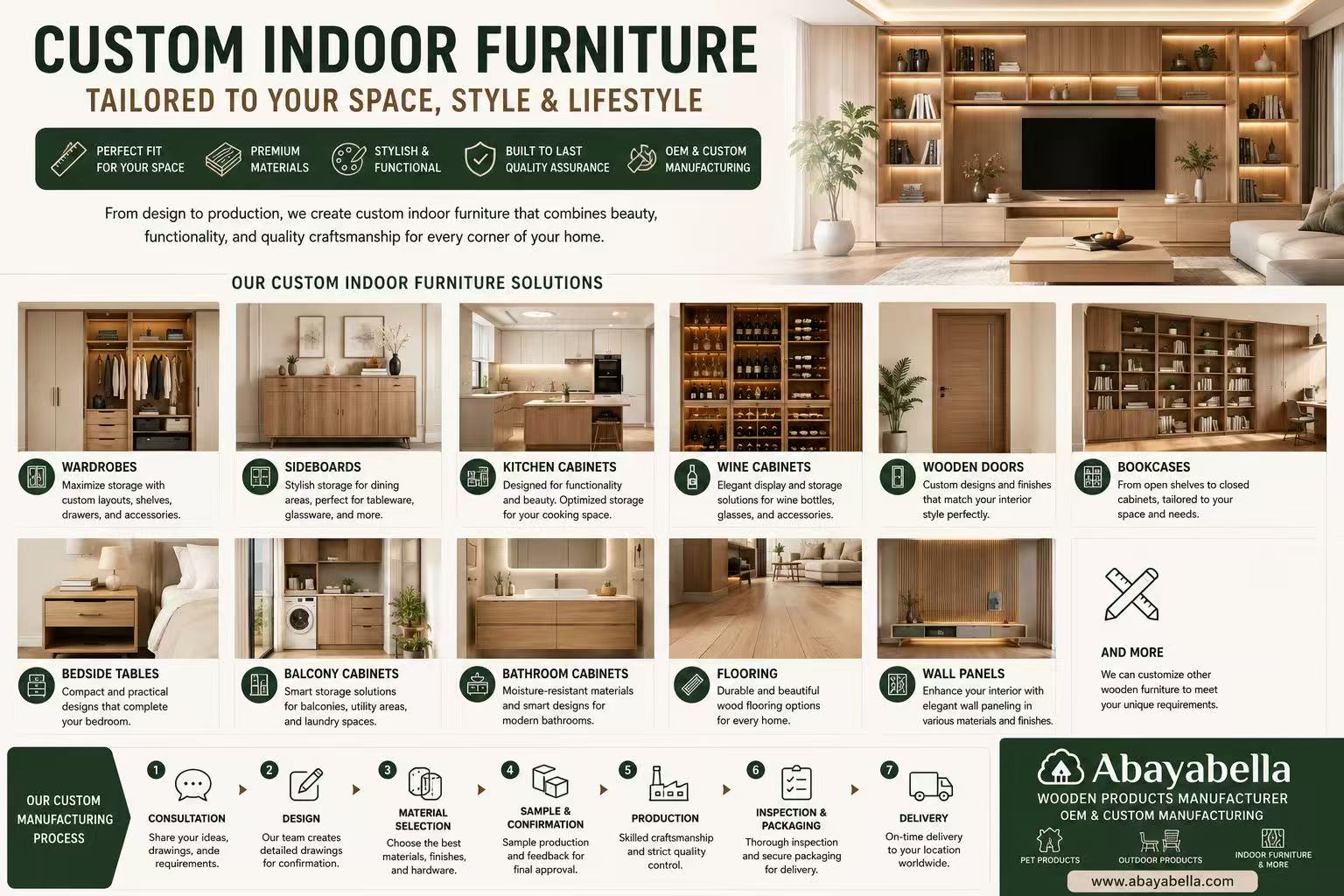
Custom Indoor Furniture: A Practical Guide to Materials, Design, Functionality, and Manufacturing
Choosing the right furniture for a home is not always as simple as buying standard products. Custom indoor furniture allows homeowners, designers, developers, retailers, and furniture brands to create solutions based on specific room dimensions, storage requirements, materials, and interior styles.
In particular, custom furniture can make better use of spaces where standard products may not fit properly. At the same time, customized production allows different furniture pieces to share consistent materials, finishes, colors, and design details.
From wardrobes and kitchen cabinets to wall panels and flooring, custom indoor furniture can be developed for different areas of a home.
This guide explains what to consider when planning custom indoor furniture, including product selection, materials, functionality, design, manufacturing, and customization.
What Is Custom Indoor Furniture?
Custom Indoor Furniture for Different Rooms and Living Spaces
Custom indoor furniture is designed or manufactured according to specific requirements rather than being limited to standard dimensions.
For example, a homeowner may need a wardrobe that fits an unusual wall, while another project may require a complete set of coordinated cabinets.
Common custom furniture products include:
- Wardrobes
- Sideboards
- Kitchen cabinets
- Wine cabinets
- Wooden doors
- Bookcases
- Bedside tables
- Balcony cabinets
- Bathroom cabinets
- Flooring
- Wall panels
- Other built-in furniture
As a result, custom indoor furniture can provide both functional and visual consistency throughout a home.
Why Choose Custom Indoor Furniture?
How Custom Indoor Furniture Can Make Better Use of Your Home
Standard furniture is designed for general applications. However, homes often have different room dimensions, wall structures, ceiling heights, and storage requirements.
Custom production can therefore provide several advantages.
Better Space Utilization
Furniture can be designed around the actual dimensions of a room. Consequently, unused gaps and difficult corners can be reduced.
Consistent Interior Design
Different furniture pieces can use matching materials, colors, textures, and finishes. In this way, the entire home can have a more coordinated appearance.
Flexible Storage
Storage requirements vary from one household to another. Therefore, shelves, drawers, cabinets, and compartments can be arranged according to specific needs.
More Design Freedom
Custom furniture allows homeowners and designers to select dimensions, materials, finishes, hardware, and other details.
Ultimately, custom indoor furniture provides greater flexibility than simply selecting individual standard products.
1. Custom Wardrobes
Custom Indoor Furniture for Bedrooms and Storage
Wardrobes are one of the most common applications for customized furniture.
A well-designed wardrobe can make better use of the available wall space while providing dedicated areas for different types of clothing and personal belongings.
Depending on the project, a wardrobe may include:
- Hanging areas
- Shelves
- Drawers
- Shoe storage
- Adjustable compartments
- Sliding doors
- Hinged doors
- Integrated lighting
Furthermore, the interior layout can be adjusted according to the user’s storage habits.
For example, a family wardrobe may require more hanging space, while a compact bedroom may benefit from a combination of drawers and vertical storage.
2. Custom Sideboards and Dining Cabinets
Custom Indoor Furniture for Dining Areas
Sideboards and dining cabinets can provide both storage and decorative value.
A custom sideboard can be designed around the dining table, wall dimensions, or overall interior style.
Common applications include:
- Tableware storage
- Glassware storage
- Kitchen overflow storage
- Decorative display
- Small appliance storage
In addition, the cabinet can be coordinated with other furniture through matching finishes and materials.
Therefore, custom indoor furniture can help create a more consistent transition between the kitchen, dining area, and living space.
3. Custom Kitchen Cabinets
Functional Custom Indoor Furniture for Modern Kitchens
Kitchen cabinets need to balance storage, accessibility, durability, and appearance.
Unlike simple freestanding furniture, kitchen cabinetry often needs to work around:
- Countertops
- Appliances
- Plumbing
- Electrical connections
- Windows
- Doors
- Wall dimensions
Because every kitchen has different requirements, customization can be particularly useful.
For example, cabinet dimensions can be adjusted to accommodate refrigerators, ovens, dishwashers, sinks, and other appliances.
Moreover, storage layouts can be developed around cooking habits and household needs.
4. Custom Wine Cabinets
Custom Indoor Furniture for Wine Storage and Display
Wine cabinets can combine practical storage with interior decoration.
Depending on the design, they may include:
- Bottle storage
- Glass holders
- Display shelves
- Drawers
- Lighting
- Closed storage
- Open display areas
A customized design can also be integrated into a dining room, kitchen, living room, or dedicated wine area.
As a result, the cabinet becomes part of the overall interior rather than simply a separate storage product.
5. Custom Wooden Doors
Custom Indoor Furniture and Interior Woodwork
Wooden doors can have a significant influence on the appearance of an interior.
Custom production allows doors to be developed according to specific dimensions, materials, finishes, and design requirements.
Depending on the project, customized wooden doors can coordinate with:
- Wardrobes
- Wall panels
- Flooring
- Kitchen cabinets
- Bookcases
- Other interior woodwork
In this way, custom indoor furniture can be combined with customized interior elements to create a more unified design language.
6. Custom Bookcases
Custom Indoor Furniture for Books, Displays, and Storage
Bookcases are often designed around the dimensions of a particular wall.
A custom bookcase can provide a combination of open shelves, closed cabinets, drawers, and display areas.
For example, a living room bookcase may combine books with decorative objects, while a home office may prioritize practical storage.
Furthermore, floor-to-ceiling designs can make better use of vertical space.
7. Custom Bedside Tables
Small Custom Indoor Furniture With Practical Functions
Bedside tables may be smaller than wardrobes or cabinets, but they can still benefit from customization.
A customized bedside table can be designed to match the bed, wardrobe, flooring, and other bedroom furniture.
Useful features may include:
- Drawers
- Open shelves
- Charging areas
- Cable management
- Storage compartments
Therefore, even smaller furniture pieces can contribute to a consistent bedroom design.
8. Custom Balcony Cabinets
Custom Indoor Furniture for Difficult or Limited Spaces
Balconies often have unusual dimensions and may contain structural columns, windows, pipes, or other obstacles.
For that reason, standard cabinets may leave unused space.
Custom balcony cabinets can be designed around the available area while providing storage for household items, cleaning equipment, tools, or other belongings.
In addition, suitable materials and finishes should be selected according to the balcony’s environmental conditions.
9. Custom Bathroom Cabinets
Custom Indoor Furniture for Bathrooms and Wet Areas
Bathroom cabinets need to combine storage with appropriate material performance.
Moisture and humidity should therefore be considered during material selection.
Depending on the application, bathroom furniture may include:
- Vanity cabinets
- Mirror cabinets
- Storage cabinets
- Open shelves
- Drawer units
Furthermore, customized dimensions can help make better use of compact bathrooms.
A carefully planned design can integrate the sink, mirror, storage, and other elements into one coordinated solution.
10. Custom Flooring and Wall Panels
Extending Custom Indoor Furniture Into the Overall Interior
Customization does not have to stop at cabinets and standalone furniture.
Flooring and wall panels can also contribute to a consistent interior design.
Matching materials and finishes can help connect different areas of a home.
For example, flooring, wall panels, doors, wardrobes, and cabinets can be developed around a similar color palette or wood appearance.
As a result, custom indoor furniture can become part of a broader interior woodwork solution rather than a collection of unrelated products.
How to Choose Materials for Custom Indoor Furniture
Custom Indoor Furniture Materials for Different Applications
Material selection should depend on the furniture’s function, location, appearance, and expected service life.
Common materials can include:
- Solid wood
- Plywood
- Engineered wood
- Decorative panels
- Wood veneer
- Laminated surfaces
- Other wood-based materials
Solid wood can provide a natural appearance and distinctive texture.
Meanwhile, plywood and engineered wood can offer consistent dimensions and flexible manufacturing possibilities.
For cabinets and built-in furniture, surface finish is also important because it influences both appearance and everyday maintenance.
Therefore, material selection should be discussed together with the intended application rather than considered separately.
How Is Custom Indoor Furniture Manufactured?
From Design Concept to Finished Custom Indoor Furniture
A well-organized manufacturing process can make customization more efficient.
A typical project may follow several stages:
Design Concept → Specification → Material Selection → Sampling → Modification → Production → Quality Control → Packaging → Delivery
First, the customer’s requirements and product specifications are reviewed.
Next, materials, dimensions, structure, and finishes are confirmed. If necessary, a sample can then be developed for evaluation.
After adjustments are completed, production can begin.
Finally, finished products are inspected, packaged, and prepared for delivery.
Consequently, clear communication at the beginning of the project can reduce unnecessary modifications later.
Custom Indoor Furniture for Different Customers
Solutions for Homeowners, Designers, Retailers, and Brands
Different customers may require different levels of customization.
Homeowners
Homeowners may need furniture designed specifically for their rooms, storage requirements, and interior preferences.
Interior Designers
Designers may require furniture that follows specific drawings, dimensions, materials, and visual concepts.
Developers and Projects
Residential projects may require multiple furniture categories with consistent specifications and finishes.
Retailers and Brands
Furniture brands may need OEM products developed according to their own designs, packaging, and market requirements.
Therefore, custom indoor furniture can serve both individual projects and larger commercial applications.
What Should You Consider Before Ordering Custom Indoor Furniture?
A Practical Checklist for Buyers
Before starting a customization project, consider:
- Room dimensions
- Product dimensions
- Storage requirements
- Material selection
- Surface finish
- Hardware
- Product structure
- Color
- Assembly requirements
- Packaging
- Delivery requirements
- Expected service life
In addition, provide accurate measurements and clear design references whenever possible.
For OEM projects, technical drawings, samples, photographs, or product specifications can also help the manufacturer understand the requirements more efficiently.
How to Choose a Custom Indoor Furniture Manufacturer
Finding the Right Manufacturing Partner for Your Project
Choosing a manufacturing partner is an important part of a customized furniture project.
A suitable manufacturer should be able to understand product specifications, work with different materials, manage production, and maintain consistent quality.
When comparing manufacturers, consider:
- Manufacturing experience
- Material capabilities
- Customization capabilities
- Production consistency
- Quality control
- Packaging
- Export experience
- Communication
- Product development support
Moreover, the lowest quotation is not necessarily the best choice.
Instead, buyers should evaluate the overall combination of quality, customization, communication, production capability, and long-term value.
Custom Indoor Furniture and OEM Manufacturing
Developing Furniture for Your Own Brand or Project
OEM manufacturing can be particularly useful for furniture brands and overseas buyers.
Rather than purchasing standard products, customers can work with a manufacturer to develop products according to their own requirements.
Customization may include:
- Product dimensions
- Materials
- Colors
- Finishes
- Hardware
- Structures
- Branding
- Packaging
At Abayabella, we support custom wooden product manufacturing for different applications.
You can explore our wooden products and manufacturing range to learn more about our capabilities.
Frequently Asked Questions About Custom Indoor Furniture
Common Questions From Buyers
What Is Custom Indoor Furniture?
Custom indoor furniture is furniture designed or manufactured according to specific dimensions, materials, functions, finishes, or design requirements.
It can include wardrobes, kitchen cabinets, sideboards, wine cabinets, bookcases, bathroom cabinets, doors, flooring, wall panels, and other interior products.
Is Custom Furniture More Expensive Than Standard Furniture?
Customization can involve additional design, sampling, material selection, and production work. However, it can provide better space utilization, functionality, and design consistency.
Therefore, the overall value should be evaluated based on the complete project rather than the initial unit price alone.
Can Custom Indoor Furniture Be Made From Wood?
Yes. Solid wood, plywood, engineered wood, veneer, and other wood-based materials can be used depending on the product and application.
The appropriate material depends on factors such as strength, appearance, moisture exposure, budget, and expected service life.
Can Different Furniture Products Have the Same Design?
Yes. A manufacturer can develop different products around a coordinated material and design system.
For example, wardrobes, kitchen cabinets, sideboards, doors, bookcases, and wall panels can share similar colors, finishes, and design details.
Can Abayabella Manufacture Custom Wooden Products?
Abayabella supports customized wooden product manufacturing for different applications.
Projects can be discussed based on product requirements, drawings, dimensions, reference samples, materials, and other specifications.
Final Thoughts
Custom Indoor Furniture for More Functional and Coordinated Homes
Custom indoor furniture provides an opportunity to design a home around its actual space rather than forcing standard products into every room.
From wardrobes and kitchen cabinets to wine cabinets, wooden doors, bookcases, bedside tables, balcony cabinets, bathroom cabinets, flooring, and wall panels, customized production can support many different interior applications.
Furthermore, customization allows different products to share consistent materials, finishes, colors, and design details.
For homeowners, this can improve space utilization and everyday functionality. Meanwhile, designers, developers, retailers, and furniture brands can use OEM manufacturing to create products around specific project or market requirements.
At Abayabella, we support custom wooden product manufacturing and OEM production for overseas buyers.
Ultimately, successful custom indoor furniture depends on the right combination of design, materials, manufacturing, quality control, and communication.
With a suitable manufacturing partner, a furniture concept can be developed into a practical finished product designed for its intended space.
Contact Abayabella
Looking for Custom Indoor Furniture Manufacturing?
If you are a furniture brand, retailer, distributor, interior designer, developer, importer, or homeowner looking for custom wooden furniture or OEM manufacturing, contact Abayabella to discuss your project.
We support custom wooden product manufacturing across different interior and lifestyle applications.
Website: http://abayabella.com
Explore our wooden products and manufacturing capabilities to learn more about Abayabella.
Watch our video: Abayabella on YouTube
We welcome inquiries about custom indoor furniture, custom wooden products, OEM manufacturing, and product development.
Custom furniture can make a big difference when standard sizes don’t work well with a specific space. Dimensions and functionality are often just as important as appearance.